Qwoto AI · A 4Seer Technologies product

AI-Powered RFQ And Quotation Management, Configurable For Your Industry

Qwoto AI takes incoming RFQs through extraction, technical evaluation, pricing, specification sheets and proposals in one connected workflow, with your team approving every step. The platform is configured around the terminology, rules and documents of your industry.

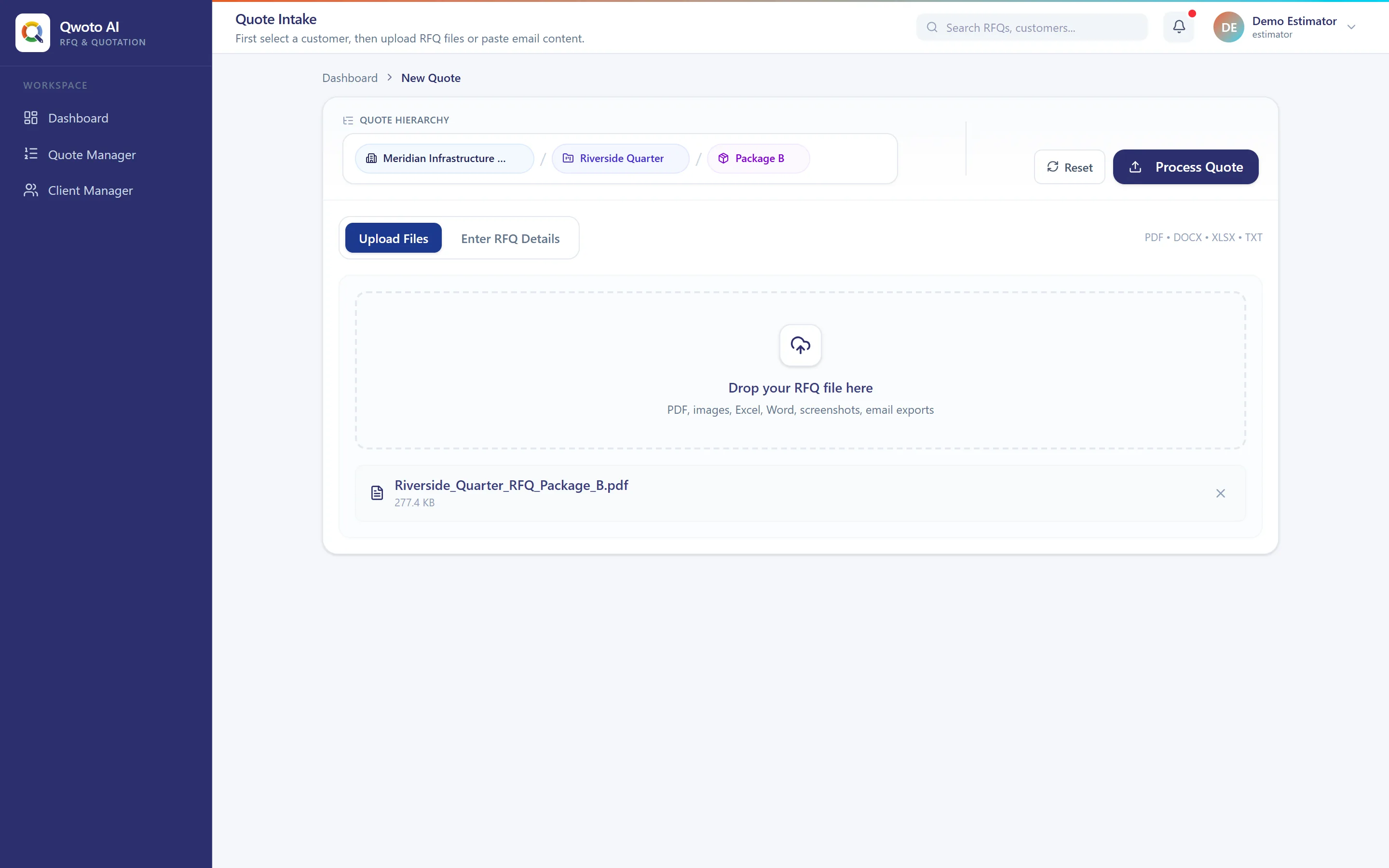
Qwoto AI Quote Intake: customer, project and package selected, with an RFQ PDF attached and ready to process.

Discover the platform

About Qwoto AI

Qwoto AI is an AI-powered RFQ and quotation management platform from 4Seer Technologies. It takes the requests businesses actually receive, such as an email, a schedule, a spreadsheet or a marked-up PDF, and turns them into structured, checked and priced quotations.

A complex quote is rarely one job. Someone reads the request, someone checks it against standards, someone works out the cost, someone chases suppliers and someone formats the proposal, usually across several spreadsheets. Qwoto AI connects those steps in one workspace, so nothing is retyped and your experts spend their time on decisions.

The workflow is the same for every business. The knowledge, rules, pricing logic and document formats behind it are configured for the industry it serves.

See it working

From RFQ To Approved Quotation

Seven stages take a request from the inbox to an approved quotation. Each one hands its result to the next.

Receive and understand

  1. 1

    RFQ Intake

    Upload a PDF, image, spreadsheet, Word file or saved email, or paste the text, under the right customer, project and package.

  2. 2

    AI Processing

    The AI reads the request in several passes and extracts each line item with a confidence score.

  3. 3

    Requirement Review

    Structured requirements are shown with missing or inferred fields, and a clarification email is drafted for your team to review and send.

Evaluate and price

  1. 4

    Engineering Review

    Each line is checked against the configured standards and rules, then approved or corrected.

  2. 5

    Pricing

    Costs are built from the approved specification, then margin, freight and supplier offers are applied.

Prepare and approve

  1. 6

    Quotation Preparation

    Specification sheets and the proposal are prepared from the approved, priced lines.

  2. 7

    Review And Approval

    Your team reviews and approves the outcome, then downloads the final proposal.

The quotation workflow

One Connected Workflow, Not Separate Tools

  • Incoming RFQ — Each request is filed under its customer, project and package, so everything that follows stays attached to the right job.
  • Requirement extraction — Extracted line items become the input for the technical check. Nothing is retyped, and the gaps found here become questions for the customer.
  • Technical evaluation — Only the approved specification moves on, so the price is built from what will actually be supplied.
  • Pricing — Priced lines keep their specification, so the documents describe exactly what was costed.
  • Specification preparation — Specification sheets and drawings are produced for the same approved lines.
  • Quotation review — Prices, documents and supplier choices come together in one place for a final check.
  • Finalisation — Approved content flows into an editable proposal and a branded PDF.

One line item, followed through a construction configuration

  1. 1

    Incoming RFQ

    “UB 305×165×40 S355, 6m lengths, 120 no., mill certs required”

  2. 2

    Requirement extraction

    Section UB 305×165×40 · Grade S355 · Length 6.0 m · Qty 120 · Certificate required

  3. 3

    Technical evaluation

    Grade completed to S355JR from the project rules · certificate EN 10204 3.1 · approved

  4. 4

    Pricing

    Mass 29.0 t × material rate, cutting, delivery and margin

  5. 5

    Specification preparation

    Member B1 added to the material schedule with its section profile

  6. 6

    Quotation review

    Estimator checks the line, price and documents

  7. 7

    Finalisation

    Line 1 appears in the proposal PDF for the customer

Sample data. Section and grade designations follow UK/European conventions.

Platform modules

The Modules Behind Every Quote

Each module covers one part of the quotation. Together they share the same data, from the first line of the RFQ to the final proposal.

RFQ Processing

Turns incoming requests into structured, reviewable requirements.

  • Document, email and text intake
  • AI extraction with a confidence score per line
  • Missing and inferred fields flagged
  • Clarification email drafted for your team
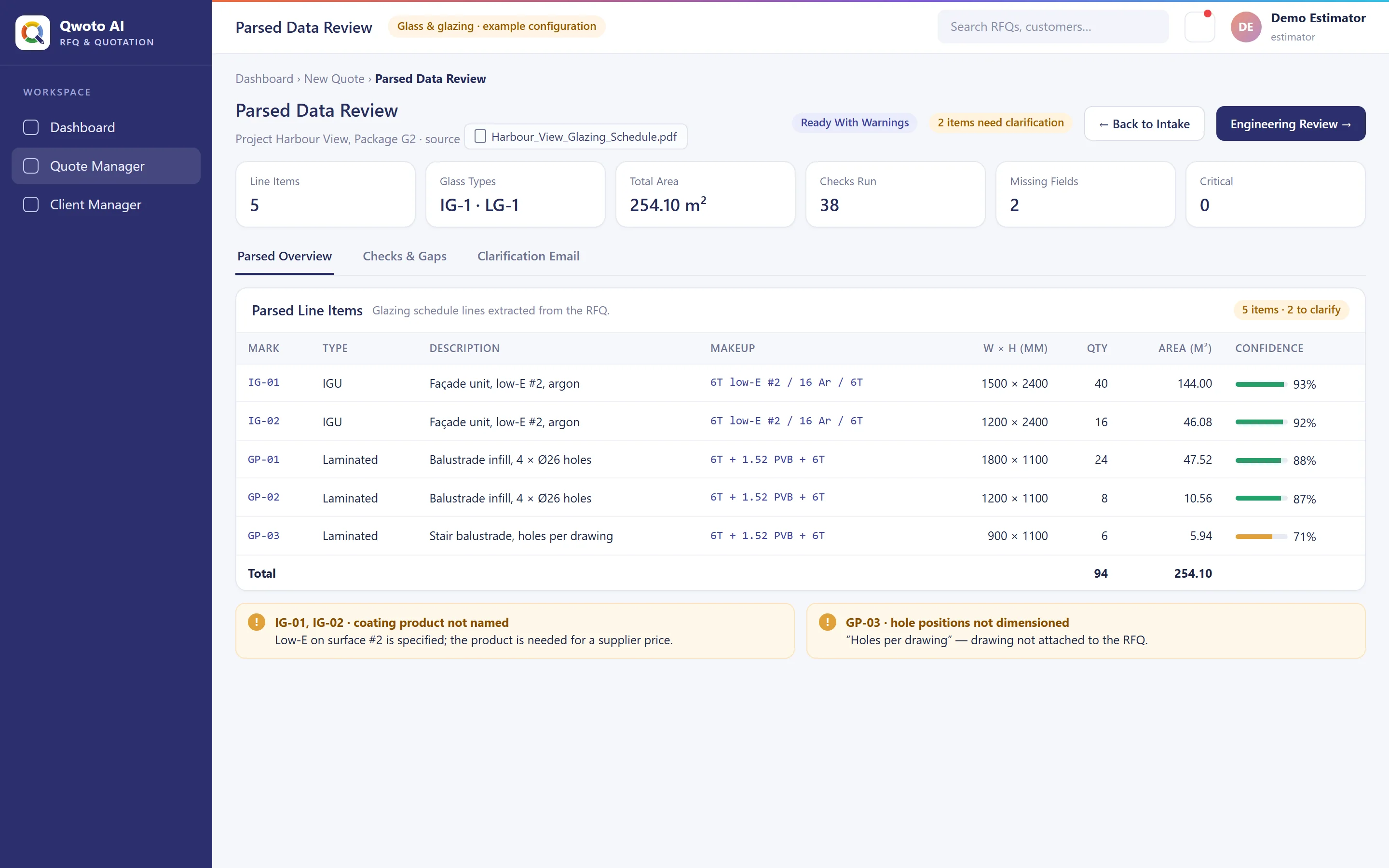
Parsed Data Review: line items with type, size, quantity and confidence, plus status, checks run and missing fields.

Pricing Engine

Builds the quotation price up from the approved specification, rather than applying a single rate.

  • Material quantities priced at current market rates
  • Further materials and processing from the cost model
  • Margin matrix with adjustments and guardrails
  • Freight, discounts and uplifts, each recorded

The cost model can be configured per industry, for example material consumption, processing and finishing for fabrication, or area, processing and edgework for glazing.

How the quotation price is built Sample values

Raw materialQuantities from the specification × market rates
33,915.39
Other materials and processingFurther materials and manufacturing
11,531.22
Base cost
45,446.61
Currency bufferExchange rate plus buffer
1,280.00
MarginMargin matrix plus adjustments
20,993.11
FreightDelivery and zone margin
4,830.00
Quotation total
72,549.72

Specification Sheets

Generates a technical document for each approved line, in the format the industry expects. Cable sheets are generated today; other industry formats are configured per deployment.
  • Construction and dimensional data
  • Technical ratings and applicable standards
  • Marking, notes and approval boxes
  • PDF output, approved or flagged by a reviewer
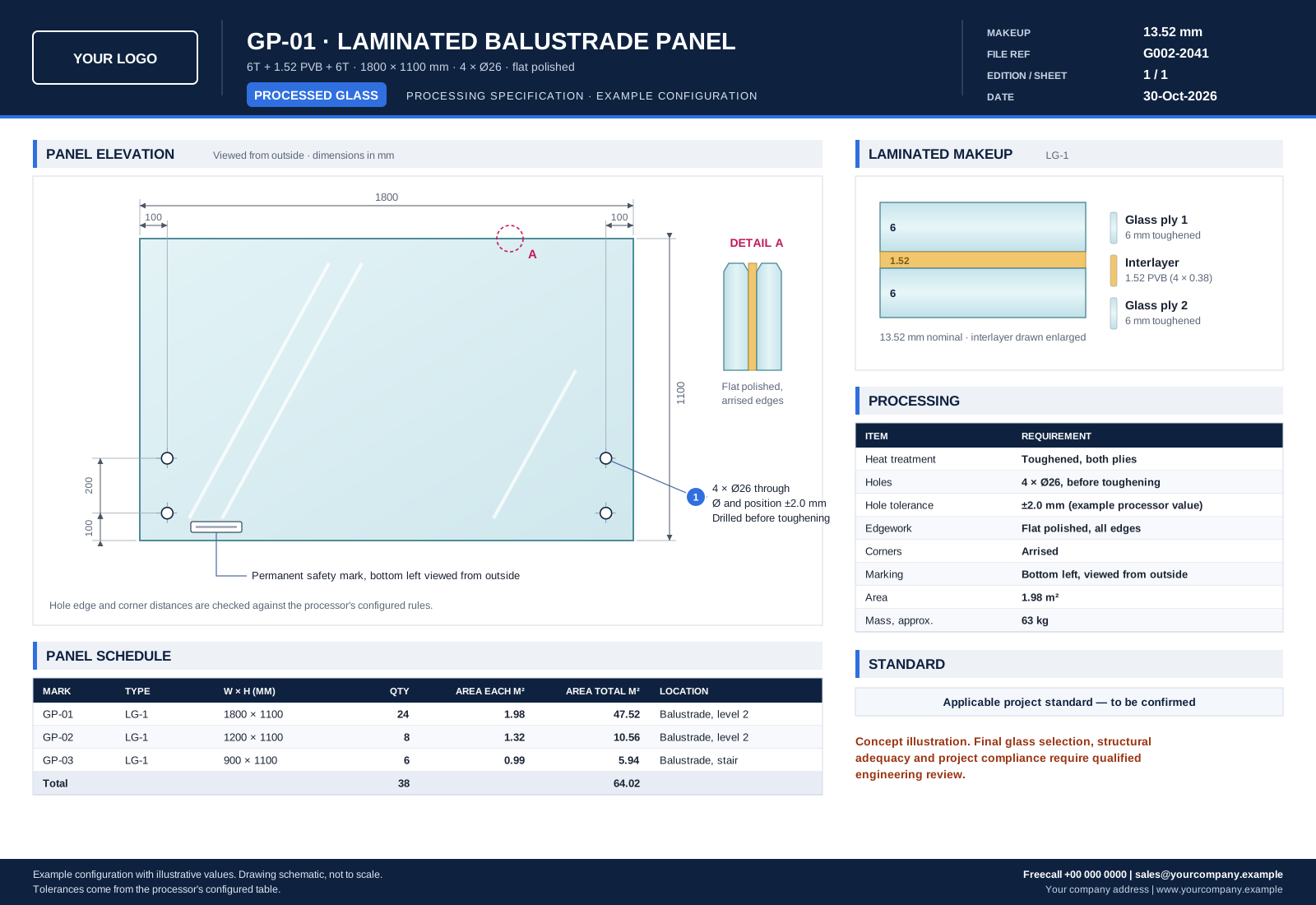
Glass processing sheet for a laminated balustrade panel.

Technical Diagrams

Represents the specification visually, in the drawing language of the industry. Qwoto AI draws cable cross-sections today; other industries show how a configured deployment would present its technical information.
  • Cable cross-sections drawn by a rules-based engine from the approved specification
  • Layer legends and callouts, embedded in the specification sheet
  • Drawings are added only where they can be drawn reliably from confirmed data
  • Customer drawings are read for quotation, not redrawn
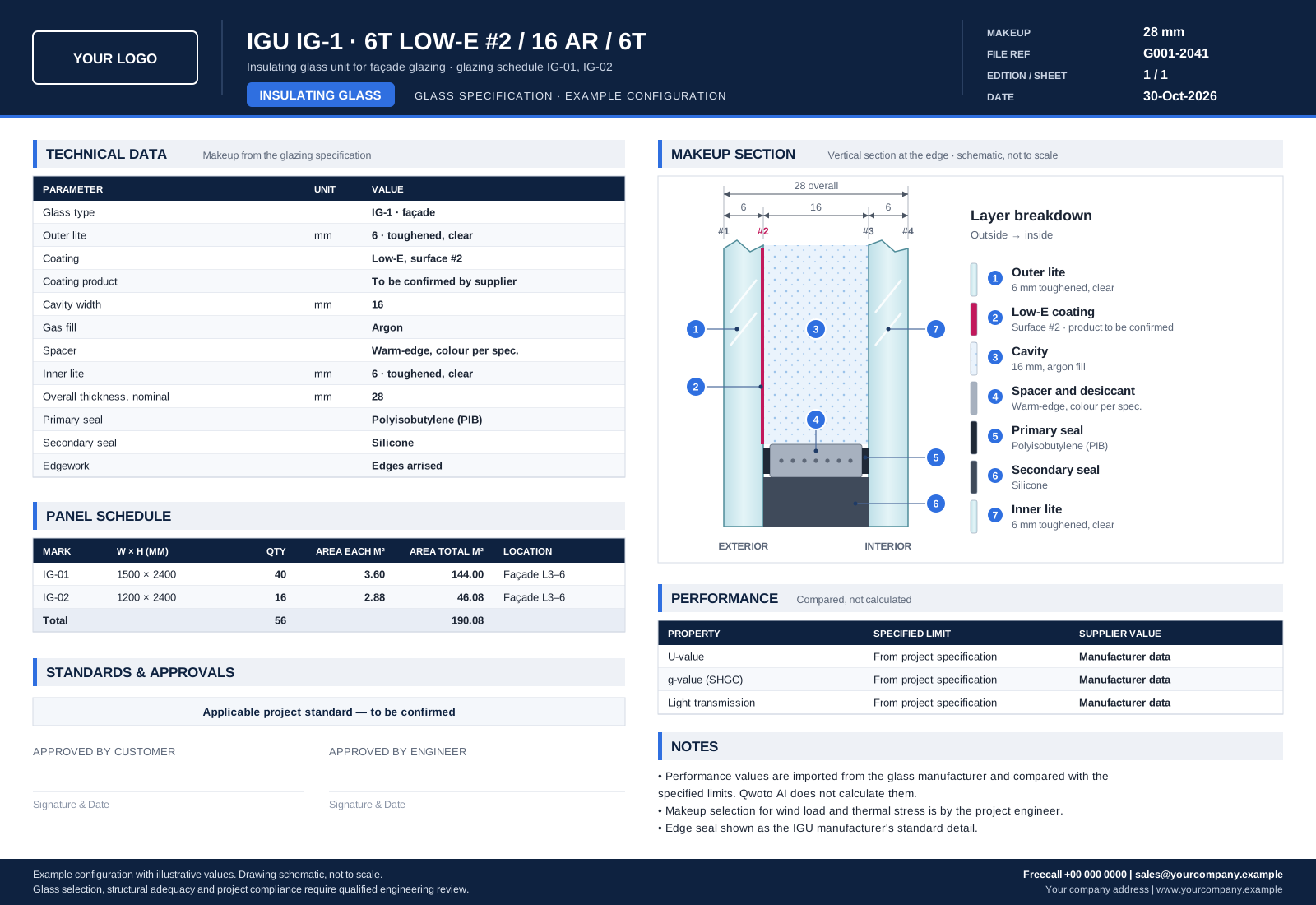
  • IGU makeup section with layer legend and panel schedule.

    Glass IGU makeup

    Lites, coating surface, cavity, spacer and edge seal.

  • Laminated panel elevation with holes, edgework detail and makeup.

    Laminated panel elevation

    Holes, edgework and marking, viewed from outside.
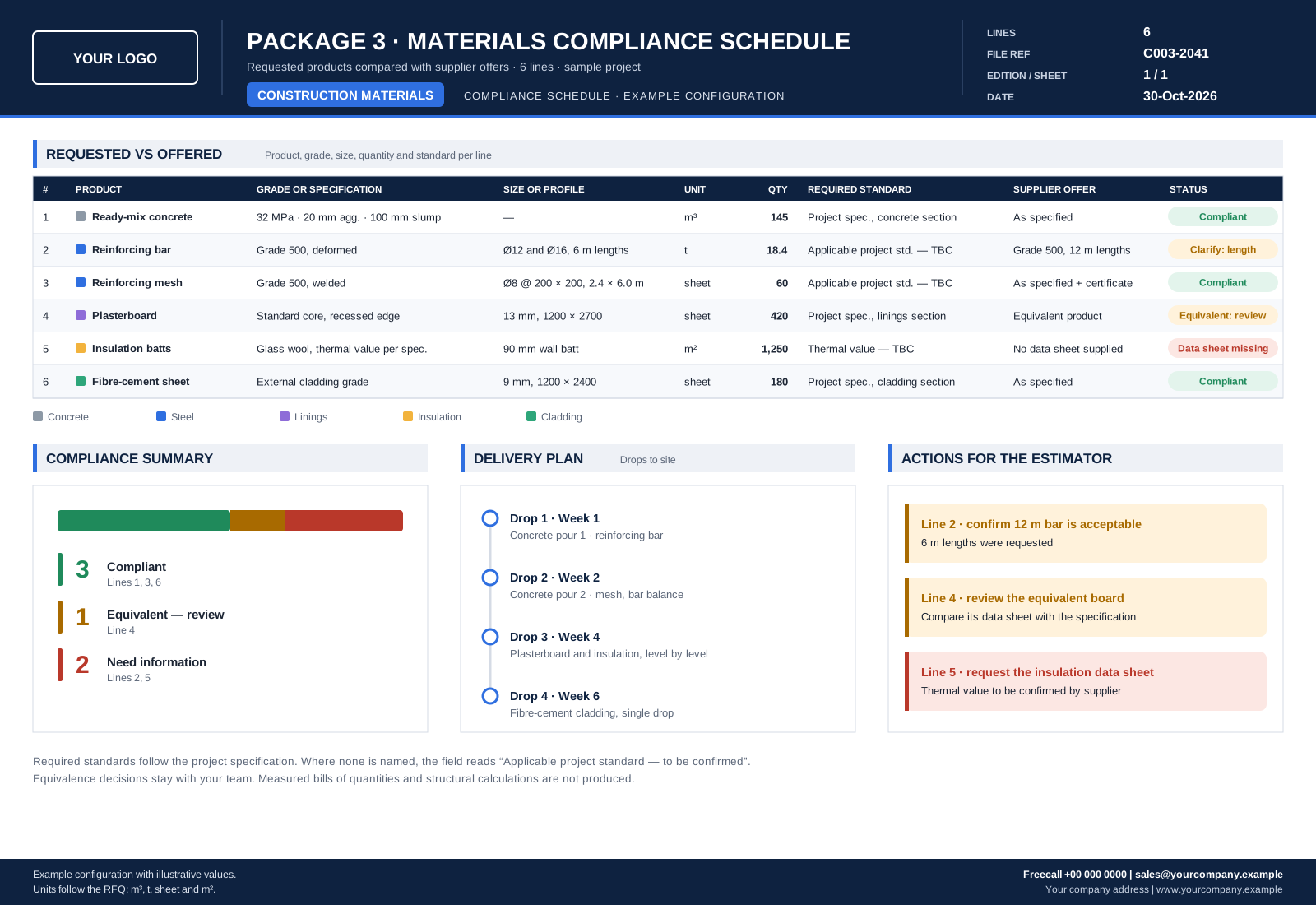
  • Construction materials compliance schedule.

    Materials compliance schedule

    Requested and offered products, with status per line.
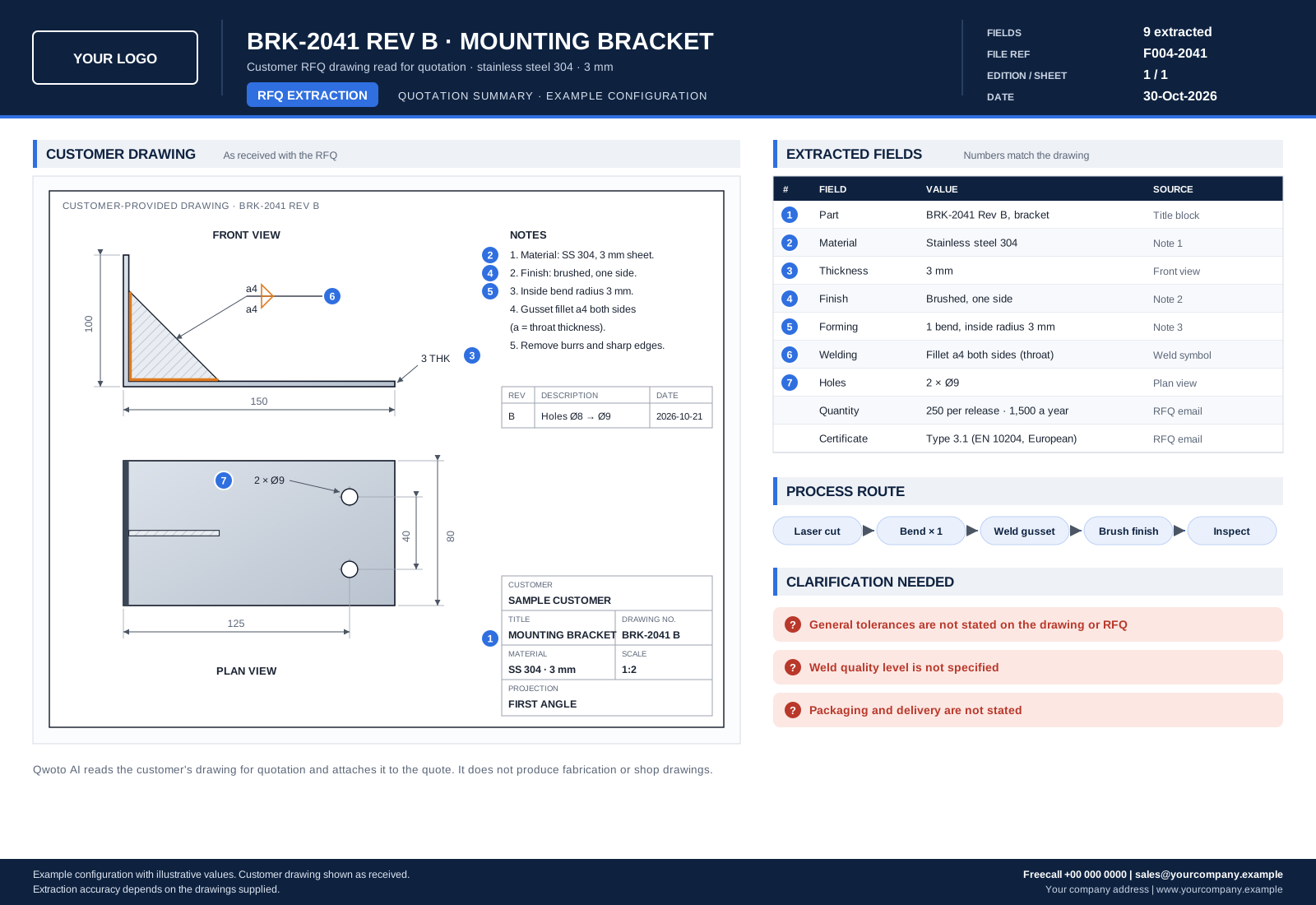
  • Quotation summary extracted from a customer's fabrication drawing.

    Drawing to quotation summary

    The customer's drawing, with the fields read from it.
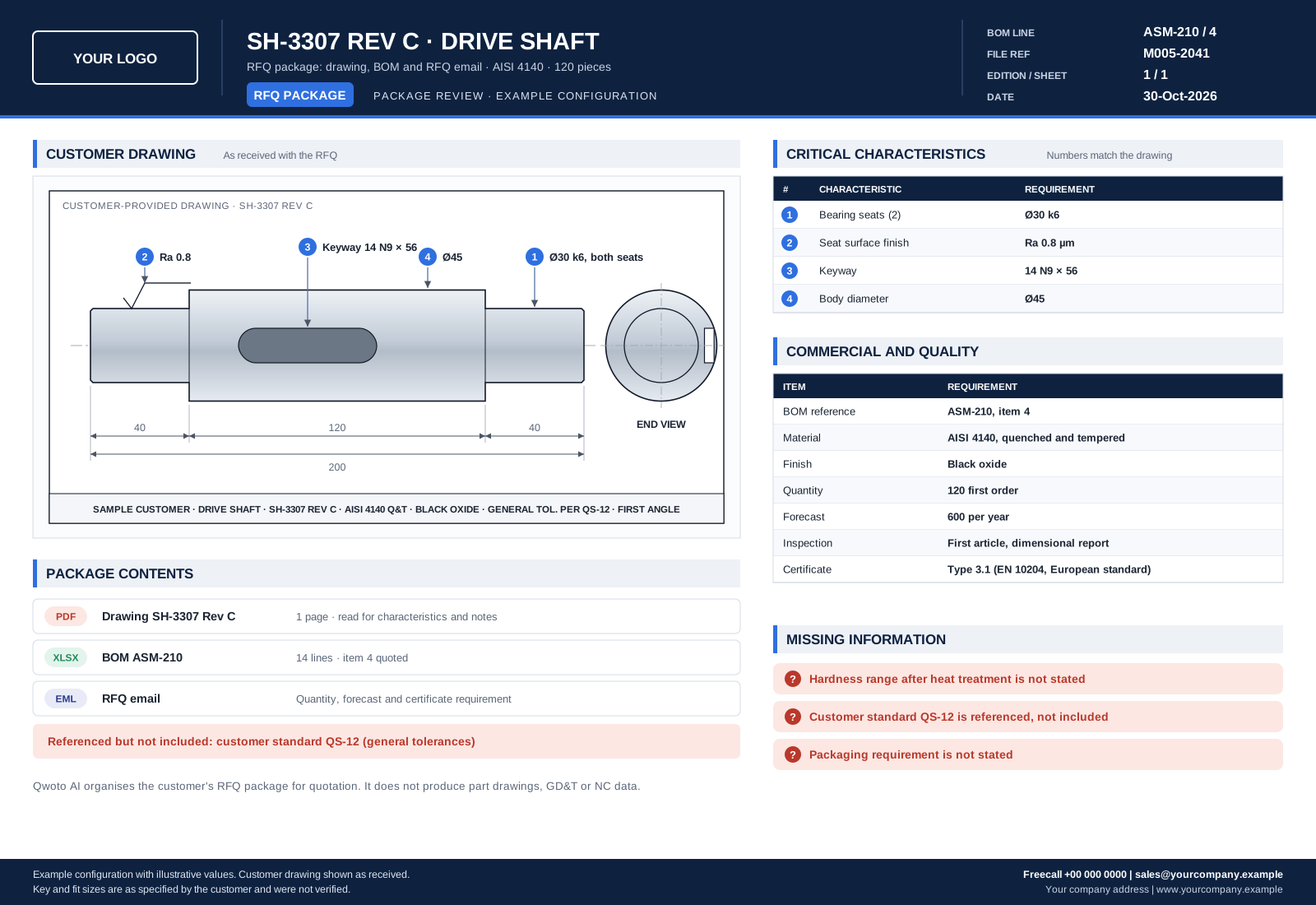
  • RFQ package review for a machined part.

    RFQ package review

    Critical characteristics, quality and missing information.

The cable cross-section is generated by the application today. The other examples show industry configurations with illustrative values.
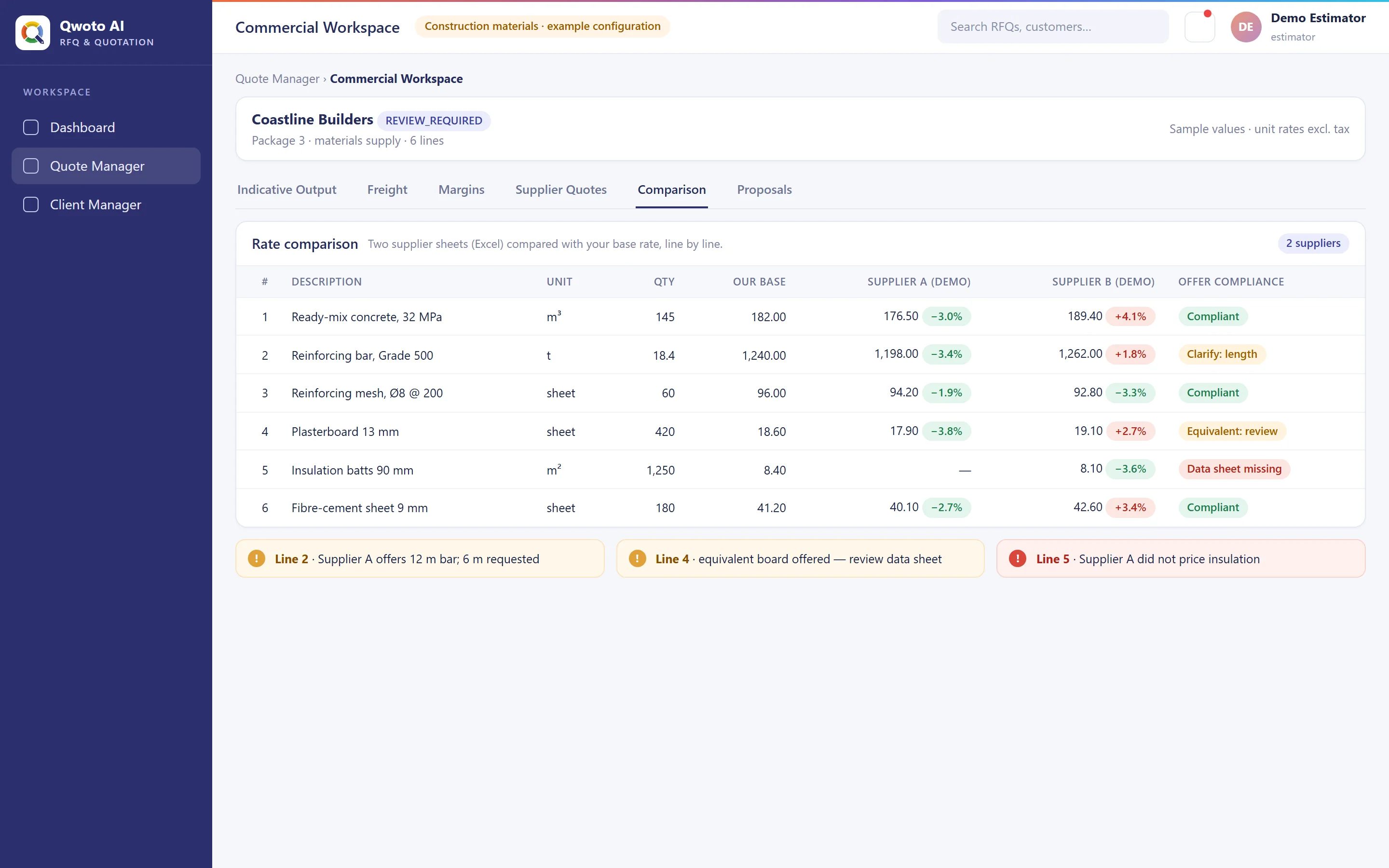
Supplier offers compared with the base price, with one chosen for the final proposal.

Supplier Comparison

Up to three supplier Excel or CSV sheets per quote, read by AI and compared line by line with your base price.
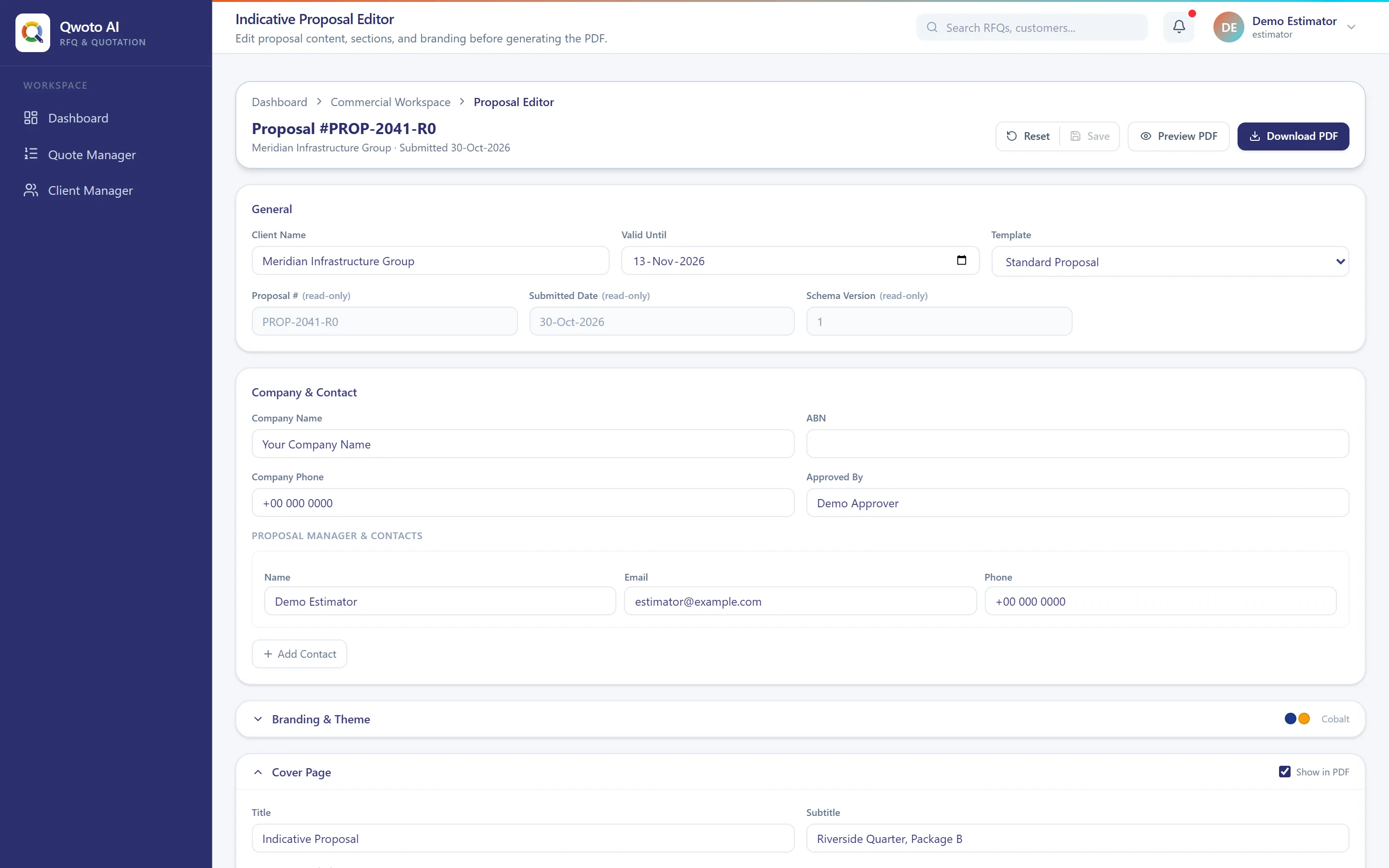
Proposal editor with general details, company and contact fields.

Proposals

Indicative and final proposals with themes, sections and delivery terms, exported as a branded PDF.
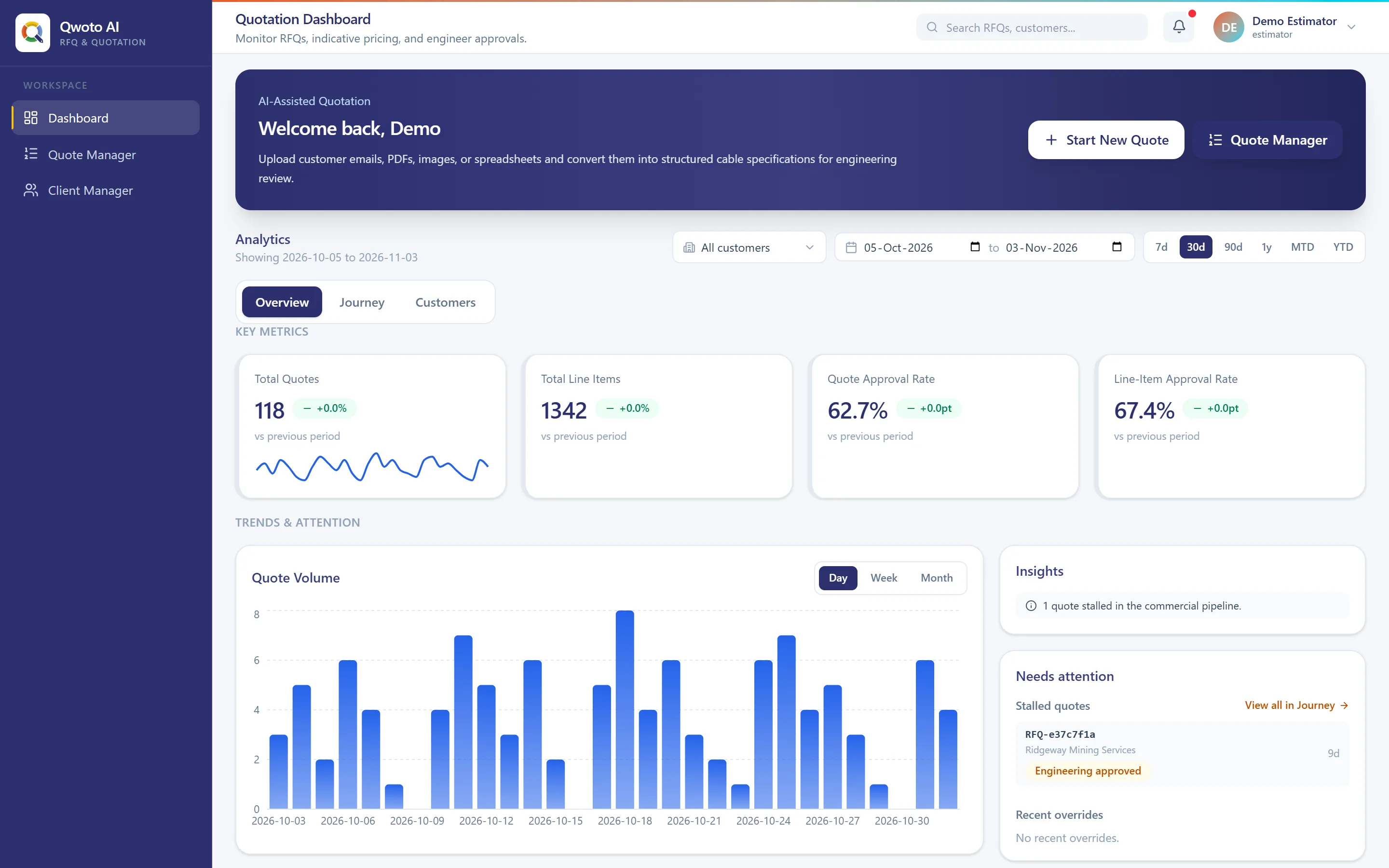
Dashboard with quote volume and approval rates.

Dashboard

Quote volume, approval rates, progress from RFQ to proposal and stalled quotes for your business.
See Qwoto AI at work

Product In Action

Parsed Data Review for a glazing schedule: IGU and laminated panel marks with makeup, size, quantity, area and
confidence, and two clarification items.
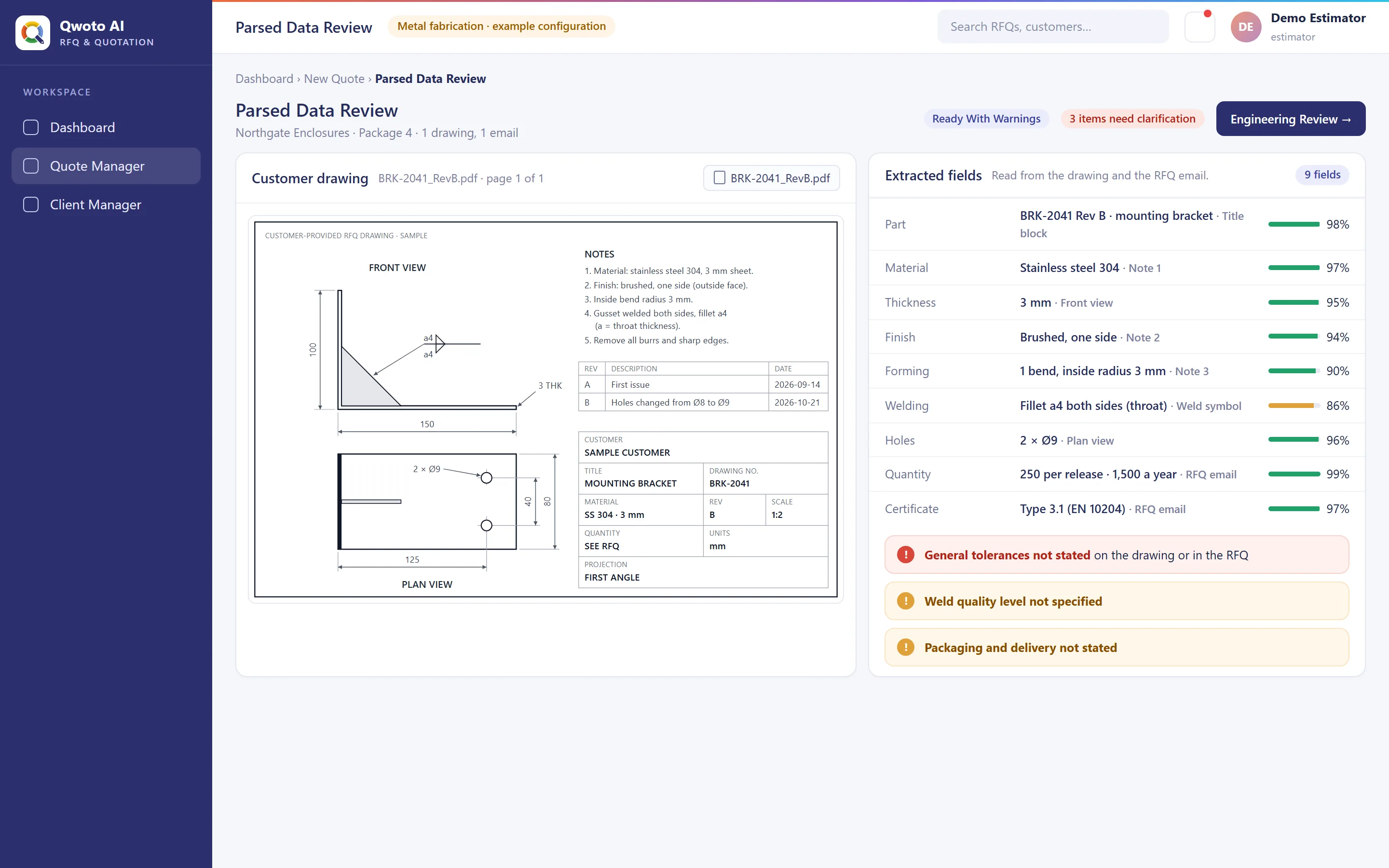
Parsed Data Review for a fabrication RFQ: the customer's bracket drawing beside nine extracted fields with confidence
and three clarification items.
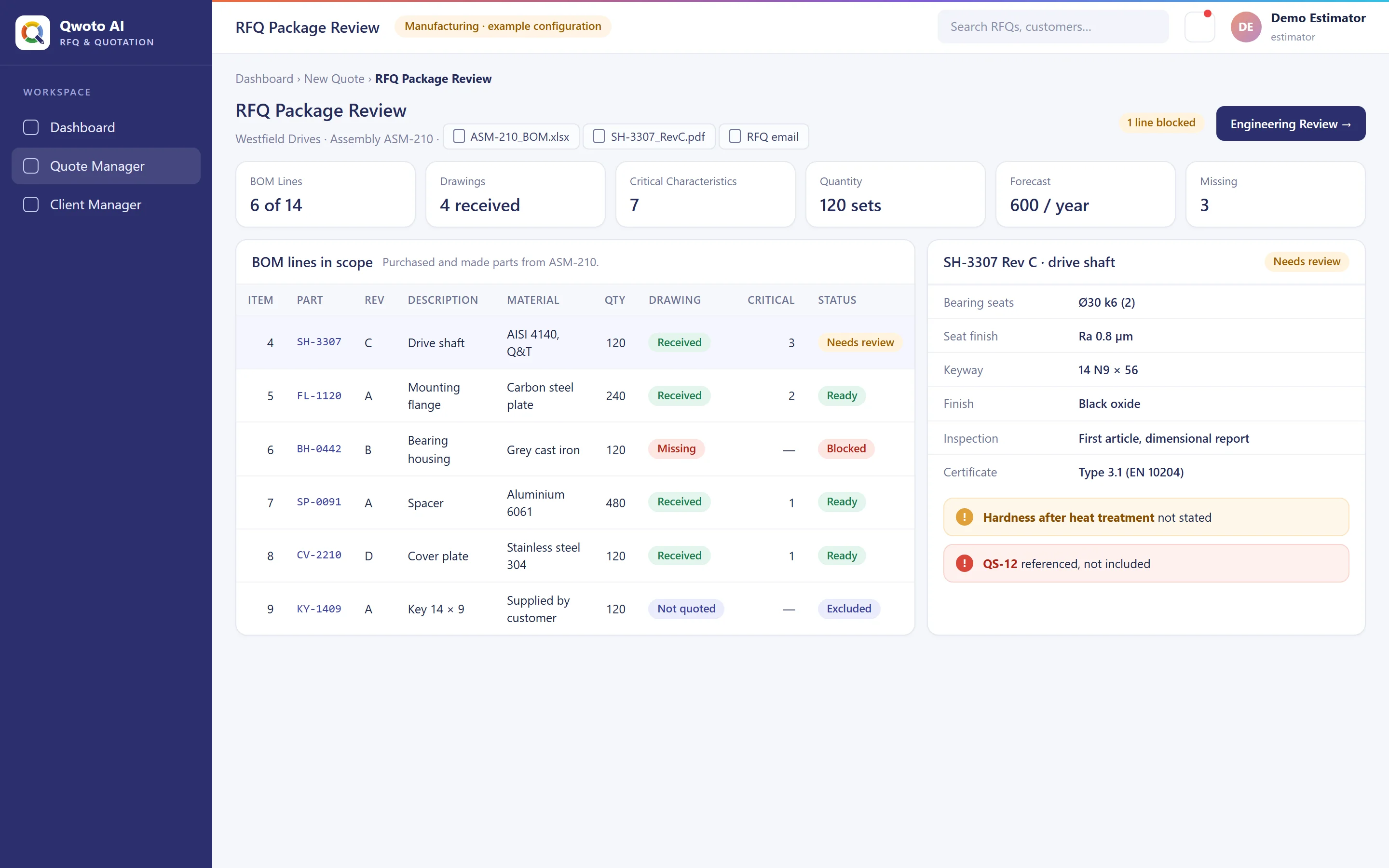
RFQ Package Review for a manufacturing assembly: BOM lines with revisions, drawings received, critical characteristics
and status, and the drive shaft's requirements.
Rate comparison for construction materials: two supplier sheets compared with the base rate, with offer compliance per line.
Quotation
Dashboard: total quotes, line items, approval rates, quote volume and stalled quotes.

RFQs arrive in every format

Intake accepts PDF, image, Excel and CSV, Word and saved email files. What is extracted from them is configured for each industry: cable schedules today, and glazing schedules, materials lists, drawings and BOMs as part of a configuration.

  • EMLRFQ email with attachmentsSaved .eml or .msg
  • XLSXCable scheduleSpreadsheet
  • PDFGlazing scheduleGlass types and sizes
  • PDFFabrication drawingViews, notes, title block

Configurable intelligence

Every Industry Quotes Differently

Qwoto AI adapts to the way your industry works. The same quotation platform is given the knowledge and rules of your industry, so it can interpret your RFQs, evaluate your requirements, support your pricing and prepare the technical outputs your customers expect.

  1. 1

    Industry requirements

    How your business quotes, and the documents it receives and sends.

  2. 2

    Knowledge base

    Terminology, products, materials, specifications and standards.

  3. 3

    Industry rules

    Validation rules, engineering checks and pricing logic.

  4. 4

    AI understanding

    RFQs are read and evaluated in your industry’s context.

  5. 5

    Industry-specific outputs

    Structured requirements, prices, specification sheets and drawings.

What can be supplied

  • Industry terminology
  • Product and material knowledge
  • Technical specifications
  • Engineering standards
  • Validation rules
  • Pricing logic
  • Specification sheet formats
  • Technical drawing conventions

One platform, configured per industry

The intake, review screens, pricing framework, specification sheets and proposals stay the same. What is configured is the intelligence behind them. You are not getting five different applications: you are getting one quotation platform set up around your business. Each deployment is configured for one industry.

Industry examples

What Configuration Looks Like In Your Industry

Cable, glass and glazing, construction materials, fabrication, manufacturing and more. Each example shows the RFQs, the technical requirements, the pricing logic and the technical documents that Qwoto AI is configured around.

Glass And Glazing

Schedules of processed glass for balustrades, façades, partitions and screens, with a glazing specification.

Technical requirements

  • Makeup and thickness
  • Sizes, holes and edgework
  • Safety glazing requirements

What the AI needs to understand

Glass types and makeups, interlayers, processing terms and safety classes.

How pricing is built
Glass
By area for each makeup
Processing
Toughening, heat soaking and laminating
Edgework
By linear metre and finish
Holes and cut-outs
By piece
Handling
Stillages, packing and delivery
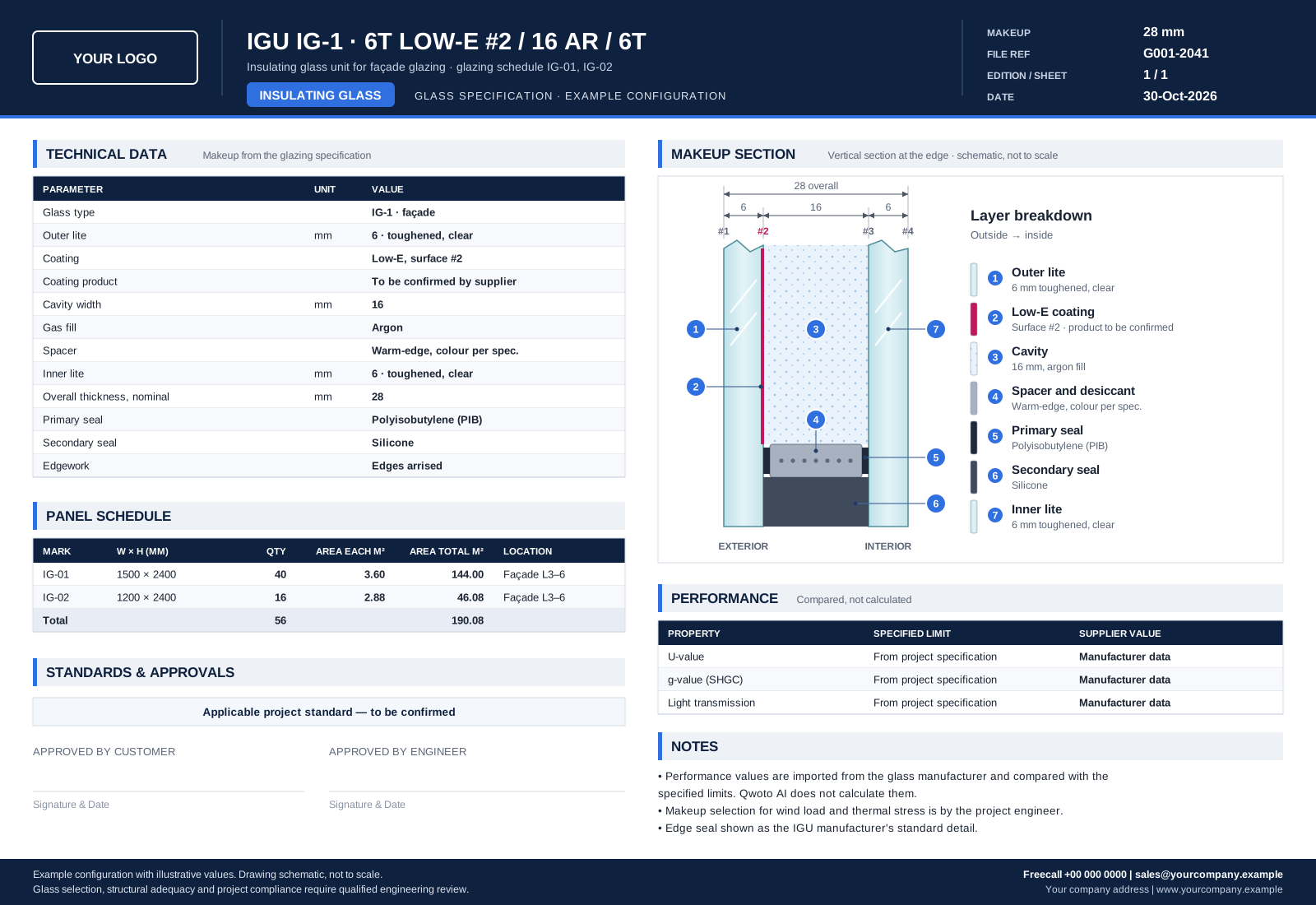
Glass specification sheet for insulating glass unit IG-1: 6 mm toughened clear outer lite with low-E coating on surface 2, 16 mm argon cavity, 6 mm toughened clear inner lite, 28 mm nominal, with a colour-coded makeup section, layer legend, panel schedule totalling 190.08 m² and performance limits compared with manufacturer data.
Insulating glass for a façade: makeup drawn from the specification, numbering surfaces from outside to inside. Performance values are manufacturer-provided, not calculated. Example configuration with illustrative values.
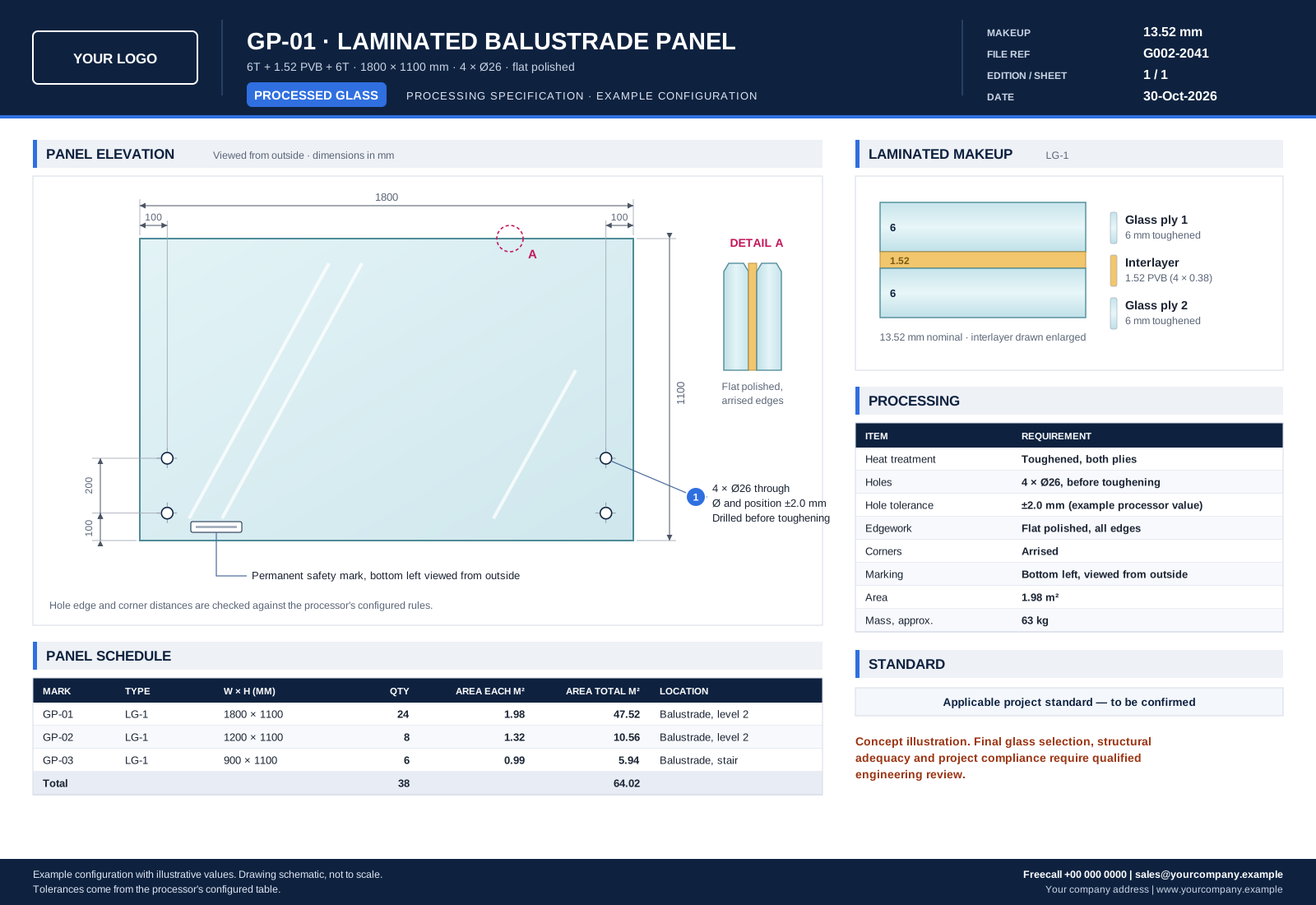
Processing sheet for laminated balustrade panel GP-01: elevation viewed from outside, 1800 by 1100 mm, four 26 mm holes, safety mark bottom left, Detail A flat polished edges, laminated makeup 6 + 1.52 PVB + 6, processing table and panel schedule totalling 64.02 m².
Laminated balustrade panel: elevation with holes and edgework, checked against the processor's rules. Example configuration with illustrative values.

Concept illustration. Final glass selection, structural adequacy and project compliance require qualified engineering review.

Construction Materials

Bills of quantities and material schedules for concrete, reinforcement, boards, insulation, cladding and other building materials, issued per project package.

Technical requirements

  • Product, grade and size
  • Compliance with the project specification
  • Phased delivery to site

What the AI needs to understand

Product designations and grades, the standards named in the specification, units such as m³, tonnes, m² and pieces, and project and package references.

How pricing is built

Material
By unit, for each product and grade
Processing
Cut to length and bending, for reinforcement
Compliance
Certificates and product data sheets
Delivery
Drops, vehicle limits and site access
Margin
By project, customer and order size
Materials compliance schedule for package 3: six requested products compared with supplier offers, three compliant, one equivalent for review, two
needing information, with a delivery plan and estimator actions.
Construction materials are specified by designation and quantity, so the output is a schedule and compliance sheet rather than a drawing. Equivalence decisions stay with your team. Example configuration with illustrative values.

Metal Fabrication

Laser-cut, folded, welded and finished parts, often sent as drawings with a parts list.

Technical requirements

  • Material grade and thickness
  • Cutting, bending and welding
  • Tolerances and surface treatment

What the AI needs to understand

Material grades and gauges, process terms, weld symbols and tolerance classes.

How pricing is built

Material
Sheet or plate consumption by part
Cutting
Laser cutting time and pierces
Forming and welding
Bend operations and weld length
Finishing
Galvanising by weight or coating by area
Margin
By customer, quantity and complexity

Qwoto AI reads customer engineering documents and organises the technical information required for quotation.

Quotation summary for BRK-2041 Rev B: the customer's bracket drawing with numbered markers beside nine extracted fields and sources, a process route and three clarification items.
The customer's drawing is the input, shown as received. Qwoto AI does not produce fabrication or shop drawings. Example configuration with illustrative values.

Other Manufacturing Industries

Machined components, assemblies and equipment defined by drawings, materials and tolerances, such as shafts, flanges and frames. The same approach applies to other industries that quote specified work.

Technical requirements

  • Dimensions and tolerances
  • Machining and surface finish
  • Inspection and certificates

What the AI needs to understand

Material grades, tolerance classes, process routes and inspection requirements.

How pricing is built

Material
Bar or billet by weight
Machining
Time per operation and setup
Treatment
Heat treatment and surface finish
Quality
Inspection and documentation
Margin
By batch size and customer
RFQ package review for drive shaft SH-3307 Rev C: the customer's drawing with numbered critical characteristics, package contents, commercial and quality requirements and three missing items.
The customer's drawing and BOM are the input. Qwoto AI does not produce part drawings, GD&T or NC data. Example configuration with illustrative values.

Each industry configuration is set up with 4Seer, using your knowledge, rules, sheet formats and drawing conventions.

People stay in control

Your Team Reviews And Approves Every Step

  • Extracted data — Missing and inferred fields are flagged. Your team decides what to ask the customer and sends the drafted email themselves.
  • Engineering — Each line is approved by a person. Choosing a non-compliant option needs a recorded reason.
  • Specification sheets — Each generated sheet is approved, or flagged with a comment.
  • Pricing and suppliers — Your team sets margins and adjustments and chooses the supplier offer for the final proposal. Prices below the margin floor are blocked until someone overrides them.
  • Proposals — Your team edits and downloads the proposal. Nothing is sent to customers or suppliers automatically.
  • Access — Roles and permissions control who can view, create and approve.

How Would Qwoto AI Quote In Your Industry?

Bring us a real RFQ, a specification sheet and a drawing from your business. We will walk you through the workflow, and what configuring Qwoto AI around your industry would involve.

  1. 1A real RFQ
  2. 2A specification sheet
  3. 3A drawing

Frequently asked questions

Questions we hear about Qwoto AI

An AI-powered RFQ and quotation management platform from 4Seer Technologies. It reads incoming RFQs, checks them against standards and your rules, builds the price, generates specification sheets and prepares proposals for your team to approve.

It is designed for businesses that quote specified work, such as construction, fabrication, cable and electrical, glass and glazing and manufacturing. The current implementation was developed for cable manufacturing, including its specification sheets and cross-section diagrams. Other industries are set up by configuring their knowledge base, rules, pricing logic and document formats with 4Seer, and what that involves depends on your business.

No. The workflow, screens, pricing framework and proposals are the same. What is configured is the intelligence behind them. Each deployment is configured for one industry, so its terminology, rules, pricing and documents stay consistent.

Each sheet is generated from the approved specification. For cable, the cross-section diagram is drawn by a rules-based engine from the specification. For other industries, sheet formats are developed as part of the configuration. Drawings are added only where they can be drawn reliably from confirmed data; customer drawings are read for quotation, not redrawn.

From the cost model configured for your business: material quantities and rates, further materials and processing, margin rules, freight and supplier offers. In the cable configuration, metal content is priced at current copper, aluminium and exchange rates.

PDFs, images, Excel and CSV files, Word documents and saved emails (.msg and .eml) with attachments, plus pasted text.

No. People review and approve at each stage. Qwoto AI prepares proposals and email drafts, and your team sends them.

Yes. The editor supports themes, custom sections and your own logos and images.