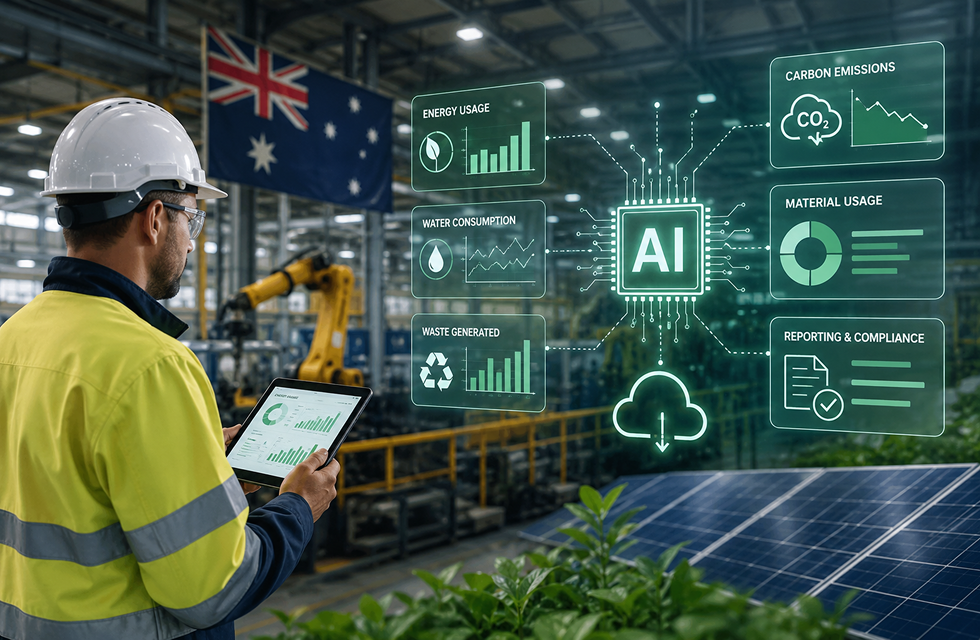
At 5:47 am on a Tuesday, the sustainability manager at a Victorian food processor is standing next to a gas boiler with a phone torch in one hand and a notebook in the other. She is reading the meter for the third time this quarter because the last two readings did not tie back to the finance team’s invoice register. Two floors up, the Plant Operations Head is on a call with an external assurer asking why the Scope 2 electricity figure moved eight per cent between the draft and final sustainability report.
That is what mandatory climate disclosure looks like inside an Australian factory in 2026. The regulation arrived. The data plumbing did not.
This blog unpacks where manual sustainability data collection is breaking on the factory floor, how AI and IoT are now closing the gap, how that layer connects into ERP systems, and what the shift looks like on real Australian production lines.
Why Sustainability Data Collection Broke on the Factory Floor
Australia’s mandatory climate-reporting regime is now live. Under the Treasury Laws Amendment (Financial Market Infrastructure and Other Measures) Act 2024, Group 1 entities began reporting against AASB S2 for financial years starting on or after 1 January 2025, with Groups 2 and 3 phasing in from July 2026 and July 2027, as DLA Piper’s summary of the new requirements sets out. Scope 3 disclosure becomes mandatory from each entity’s second reporting year, and for manufacturers, value-chain emissions typically dominate the footprint.
The problem is that most plants were never built to produce audit-grade emissions data. A Manufacturing Leadership Council survey found that around 70 per cent of manufacturers still collect operational data manually, even as 44 per cent of manufacturing leaders report that their data volumes have at least doubled in two years. On a real factory floor, that looks like:
- Utility invoices reconciled in spreadsheets weeks after the billing period closes
- SCADA and PLC logs sitting in isolation from the sustainability team
- Fuel, refrigerant, and waste records held by different vendors in different formats
- Scope 3 supplier data collected once a year through an email chase
Every handover introduces a break, and every break becomes an audit finding waiting to happen.
The AI and IoT Layer That Now Sits Between the Machine and the Ledger
The pattern taking hold in Australian plants is not “AI replaces the sustainability team.” It is a thin automation layer that sits between the physical asset and the reporting ledger, and it has three moving parts.
The IoT layer captures data at source. Smart sub-meters, thermal sensors, flow meters, and air-quality monitors emit readings at minute-level intervals directly from compressors, chillers, kilns, and paint booths. Nothing is transcribed by hand.
The AI layer does three specific jobs. It cleans and normalises heterogeneous readings so a kilowatt-hour from a 1998 substation reads the same as one from a 2024 rooftop solar inverter. It applies the correct emission factor by fuel type, jurisdiction, and reporting framework, whether NGER, the GHG Protocol, or AASB S2. And it flags anomalies, such as a night-shift energy spike or an unexplained refrigerant top-up, before they reach the final report.
A workflow layer then routes exceptions to the right operator. Instead of the sustainability manager discovering an eight-per-cent variance during audit, the shift supervisor receives an alert at 06:15 the same morning. This convergence lines up with the broader technology shift on Australian shop floors that RSM Australia’s 2026 manufacturing outlook describes, where AI-driven predictive maintenance, digital twins, and green-manufacturing investment are increasingly deployed side by side.
Connecting the Automation Layer to Your ERP
Data at the machine is only half the story. Emissions figures ultimately need to reconcile against invoices, purchase orders, and cost centres inside SAP, Oracle, Dynamics 365, or NetSuite. This is where most first-generation ESG tools fall over.
A mature integration approach uses three types of connectors:
- Direct API connectors into ERP modules for procurement, energy contracts, and freight, so purchased-goods and logistics activity data flows into Scope 3 calculations automatically
- Middleware brokers such as Azure Service Bus or Microsoft Fabric event streams that stitch OT data from the plant with IT data from the ERP, without a rip-and-replace program
- Supplier portals that let tier-one vendors submit primary emissions data against a common schema, reducing reliance on industry-average factors
The payoff for a Plant Operations Head is that energy consumption per unit produced becomes a live operating KPI rather than a lagging annual disclosure. For the Sustainability Manager, the reconciliation between meter, invoice, and disclosure narrows from weeks to hours. If you want to see how this stitches together in practice, our 4Vue data management platform is built around exactly this OT-to-IT integration challenge.
What This Looks Like on an Actual Manufacturing Floor
Three worked examples are becoming common across Australian sites.
A New South Wales metal fabrication plant instruments its induction furnaces with AI-based load monitoring. The model learns each furnace’s baseline energy signature; when a batch runs twelve per cent hotter than optimal, the system flags it in real time, and the same signal feeds Scope 1 emissions for the reporting period without a spreadsheet ever being opened.
A Queensland food and beverage producer connects refrigeration units, boilers, and packaging lines into a single event stream. AI apportions shared utilities such as compressed air and chilled water across product lines using actual load, not floor-area estimates. The GRI-aligned intensity metric per kilogram of finished product becomes defensible under assurance.
A Western Australian building-products manufacturer plugs its logistics telematics into the ERP freight module. Kilometres travelled, fuel type, and load weight roll up into Scope 3 category 4 (upstream transportation) without a supplier survey.
None of this required ripping out existing SCADA or ERP. Each site layered intelligence over what was already there.
Building the Business Case Beyond Compliance
Compliance is the trigger, but automated data collection unlocks a longer list of operating benefits that matter to the CFO as much as the CSO:
- Energy waste identified at the asset level, usually the fastest lever for Scope 1 and 2 reductions
- Fewer restatements and lower assurance costs as the regime moves from limited to reasonable assurance across the phase-in years
- Cleaner supplier data to defend product carbon claims to global customers, particularly in EU-facing supply chains subject to CBAM
- A single source of truth that finance, operations, and sustainability functions can all work from
4Seer Technologies works with manufacturers across ten countries on exactly this layer. Our 4Scope ESG reporting platform is GRI-certified and supports GRI, CDP, TCFD, CSRD, ESRS, and BRSR, while 4Vue integrates 30-plus enterprise data sources across the OT and IT estate.
For Plant Operations Heads and Sustainability Managers preparing for AASB S2 year two, the question is no longer whether to automate but where to start. Book a working session with our ESG solutions team to map your current data flows against your reporting obligations and identify the highest-yield automation points.
Frequently Asked Questions
How Does AI Automate Sustainability Data Collection in Manufacturing?
AI ingests raw readings from IoT sensors, sub-meters, SCADA systems, and utility invoices, then cleans, normalises, and tags each data point with the correct emission factor and framework. It flags anomalies before they enter the report, replacing spreadsheet transcription. For Australian manufacturers reporting under AASB S2, this turns emissions figures into a continuously updated, audit-ready dataset rather than a quarterly reconciliation exercise.
Which Australian Manufacturers Must Comply With AASB S2 Climate Disclosure?
Group 1 entities, generally those with revenue above five hundred million dollars, one billion in assets, or five hundred employees, began reporting for financial years starting on or after 1 January 2025. Group 2 follows from July 2026 and Group 3 from July 2027. National Greenhouse and Energy Reporting Act reporters are automatically in scope. Scope 3 becomes mandatory from each entity’s second reporting year.
Can AI-Driven Data Collection Integrate With Existing ERP and SCADA Systems?
Yes. Modern platforms use API connectors into ERP suites such as SAP, Oracle, and Dynamics 365, alongside middleware like Azure Service Bus or Microsoft Fabric to stream data from SCADA and PLC layers. This means manufacturers do not need to rip and replace legacy infrastructure. The automation layer sits above existing systems, reconciling operational readings with procurement, energy, and freight records inside the ERP.
How Much Does Automated ESG Data Collection Reduce Reporting Time?
Australian manufacturers moving from spreadsheet-based collection to AI-plus-IoT pipelines typically compress reporting cycles from eight to twelve weeks after year-end down to near real-time dashboards refreshed daily. Sustainability teams reclaim hours previously spent chasing meter readings and supplier submissions, while assurance preparation shortens because the underlying dataset is already traceable, versioned by source, and mapped to specific AASB S2 disclosure requirements before the auditor arrives.
What Should a Plant Operations Head Evaluate Before Selecting an ESG Automation Platform?
Focus on five criteria: native connectors into your ERP and SCADA stack, support for AASB S2 alongside GRI, CDP, TCFD, CSRD, ESRS, and BRSR, granularity of Scope 3 calculation logic, anomaly-detection capability at the asset level, and evidence of audit-ready output. A platform that treats sustainability data as a governed enterprise dataset, not a reporting side project, will hold up under assurance and internal scrutiny.