
Picture the Wednesday morning that has become routine for Australian EHS managers in 2026. The CFO wants Scope 1 and 2 emissions reconciled against financial ledgers before the audit committee meets on Friday. Legal counsel is asking whether the climate scenario language in the draft sustainability report matches what the board actually approved. The sustainability lead is chasing a supplier in Perth for Scope 3 activity data that lives in a spreadsheet nobody has version-controlled. Everyone is pulling from a different system, and the AASB S2 filing window is closing.
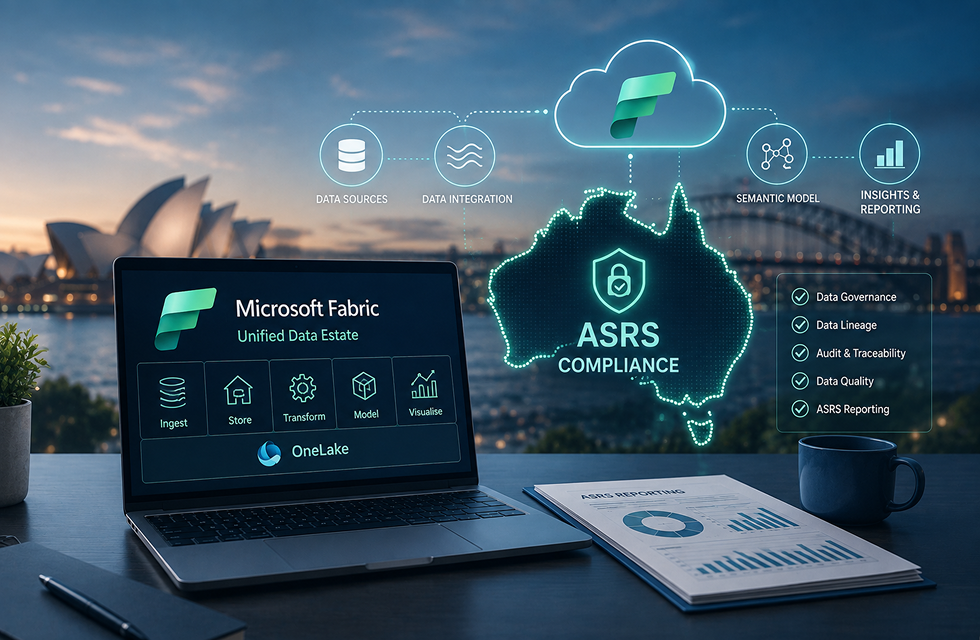
That fragmentation is the real story behind Australia’s mandatory climate disclosures, and it is why the platform question, not the framework question, now sits at the centre of ASRS readiness. This blog looks at why Microsoft Fabric is emerging as the working data foundation for AASB S2 reporting, how OneLake changes the economics of sustainability data, and what Australian teams should think through before they deploy.
Under the Corporations Act 2001, AASB S2 Climate-related Disclosures applies to annual periods beginning on or after 1 January 2025 for entities that meet the size, emissions, or asset thresholds set by Treasury. Group 1 entities are already in scope, Group 2 and Group 3 follow in staggered cohorts, and the standard requires disclosures across governance, strategy, risk management, and metrics and targets.
What that translates to operationally is a data problem, not a policy problem. Reporters need auditable Scope 1, 2, and eventually Scope 3 emissions data. They need climate-related financial information tied to the same chart of accounts finance uses. They need scenario analysis outputs that a director can sign a declaration against. And they need all of it locally, because under ASIC’s Regulatory Guide 280 Sustainability Reporting, a Chapter 2M Australian subsidiary must prepare its own sustainability report even when a foreign parent voluntarily reports on a consolidated basis.
Microsoft Fabric is a software-as-a-service analytics platform that folds data engineering, data warehousing, real-time intelligence, data science, and Power BI into a single tenant. For ASRS reporting, three properties matter more than the feature list.
The practical implication is that finance, EHS, procurement, and sustainability stop building parallel reporting stacks. They collaborate on one governed estate that maps to the four AASB S2 pillars.
OneLake is often described as the OneDrive for enterprise data, and the analogy holds for ESG use cases. A single logical lake absorbs meter data from operational technology systems, invoice-level activity data from ERP, supplier questionnaires, energy bills, and third-party climate risk feeds, then exposes them through a common namespace.
Two design choices in OneLake matter specifically for AASB S2 preparers. First, shortcuts let you reference data held in Azure Data Lake Storage, Amazon S3, or Google Cloud Storage without copying it, which is useful when Scope 3 supplier data sits with a joint venture partner outside your tenant. Second, OneLake workspaces are powered by capacities that reside in a user-selected region, so a lake can span multiple countries while honouring local residency requirements. For an Australian reporter with operations in the UAE or Singapore, that means one logical estate with region-pinned data.
For sustainability teams, the payoff is that emissions factors, activity data, and financial control totals live next to each other, versioned, with lineage. When an assurance provider asks how a Scope 2 figure was calculated, the answer is a query, not an archaeology project.
Choosing where to place Fabric capacities is not a technical footnote. It is a governance decision that legal, sustainability, and IT should make together.
The temptation is to treat Fabric as an IT project and slot ESG data in later. That inverts the risk. AASB S2 disclosures carry a directors’ declaration, and protected-statement immunity is limited and time-bound. Legal counsel should be in the room when the data model is designed, not when it is being audited.
Three alignment points repay the effort. Define what constitutes a controlled document in OneLake and who can promote a dataset from bronze to gold. Agree on retention policies for supporting evidence, since assurance is trending toward reasonable assurance by 2030. And agree the review workflow for any AI-generated narrative that ends up in a filed report.
4Seer Technologies works with Australian and multinational reporters to stand up Microsoft Fabric as the ESG data backbone, then layer 4Scope, our GRI-certified sustainability reporting platform, for AASB S2, GRI, CDP, TCFD, CSRD, ESRS, and BRSR outputs. With 30-plus enterprise data source integrations through 4Vue and delivery across ten countries, our teams help EHS, sustainability, and legal functions turn a first ASRS filing into a repeatable operating rhythm.
No. AASB S2 is technology-neutral and does not require any specific platform. What it does require is auditable, traceable, and consistent climate-related data. Microsoft Fabric is one of several platforms that can meet that bar, and it is often chosen because Australian enterprises already run Power BI, Azure, and Microsoft 365, which reduces integration effort and shortens the path to a first defensible filing.
Yes, provided you provision Fabric capacities in Australia East or Australia Southeast. Customer data at rest for those workspaces stays within Australian borders, which supports Corporations Act obligations and internal residency policies. For groups with offshore operations, OneLake still lets you span regions logically while pinning each workspace to a chosen country, so onshore and cross-border datasets remain clearly separated for audit.
Scope 3 data typically arrives in mixed formats from ERP systems, supplier questionnaires, and third-party feeds. Fabric ingests these through Data Factory pipelines, Dataflows, and OneLake shortcuts, then normalises them in a medallion architecture. Emission factors and activity data land in the same governed lake as finance data, which makes reconciliation and assurance evidence easier to produce during AASB S2 reporting cycles.
Power BI is the presentation layer for governance, strategy, risk, and metrics disclosures under AASB S2. Boards use it for climate scenario dashboards, sustainability leads use it for target tracking, and legal counsel uses it for traceability views back to source systems. Because Power BI reads directly from OneLake, the numbers in a board pack match the numbers in the filed sustainability report by construction.
Timelines vary with data maturity, but mid-market Group 2 and Group 3 reporters typically stand up a minimum-viable Fabric estate for AASB S2 in twelve to twenty weeks. That covers region setup, ingestion for priority data sources, a Scope 1 and 2 data model, and initial Power BI disclosures. Scope 3 expansion, scenario analysis, and assurance-ready controls are usually staged into a second phase.

Most business decisions today are based on data. As a...

Turning raw data into useful insights is important for businesses...
